
A complete view of our family mediation services

Steady, structured support across the issues families most often need to talk through children, finances, divorce, MIAMs, online and shuttle mediation, and the wider family conversations that matter most.

Children-centred Practical and balanced Confidential

Overview

A more consistent way through family change

Illustration of a family having a discussion together

When family life begins to shift, it often feels as though everything is happening at once. Conversations that once felt easy start to feel charged. Even small day-to-day decisions can become harder to make. For some, the situation is shaped by separation. For others, it is concern about the children, money difficulties, housing pressures, or a long stretch of disagreement that has worn everyone down.

National Mediation offers a steadier route through demanding times. Each service is built around giving families a structured space to talk through difficult issues without raising the temperature. The goal is not to make a tense situation worse. The goal is to ease it.

For most people, mediation is different because it is not built around blame. It is built around conversation. It allows people to be heard, to bring clarity to the situation, and to put real-life arrangements in place that feel grounded. That matters because family difficulty is never abstract. It shapes children, routines, homes, finances, confidence, and the futures people are trying to rebuild.

The services described on this page sit alongside one another. They include support for children, financial conversations, divorce-related discussions, MIAMs, online mediation, shuttle mediation, the Family Mediation Voucher Scheme UK, and broader family disagreements. Each is designed to keep conversation calm, respectful, and useful. They are presented together here so that families can clearly see what is offered, how each service works, and how mediation tends to provide a more thoughtful alternative to confrontation or court.

Built for real life

A full family mediation service for actual life

Families do not usually come to mediation because life is simple. They come because something has become too much to manage alone. Sometimes it is one issue. Sometimes it is several at once. More often than not, it is a mixture of emotional pressure and practical strain, with little room left for clear thinking.

An effective mediation service has to be built around that reality. It cannot feel mechanical. It needs to feel human. It must leave space for emotion without being overtaken by it. It needs to keep things moving without pushing people. It must offer structure without becoming cold or scripted. That is the foundation behind National Mediation.

The services on this page have been organised around the situations that most often bring families to mediation. Some involve children and parenting, including Child Arrangements UK Explained. Some involve money and property. Some are about understanding what comes next. Others are about supporting communication when speaking directly is too difficult. Each service complements the others, written around the same shared aim to help families move forward in a steadier, fairer, more sustainable way.

Children services

Six focused supports
Child Services Guide

Family change can feel especially difficult when children are involved. Many parents are carrying their own emotions while also doing their best to protect their children from worry, confusion, or conflict. That is rarely simple. Children pick up on more than adults realise, and they often feel changes in routines, communication, and the wider mood of the home. National Mediation's children services are designed to support more measured, calmer conversations about what supports the child best, how parents can shape that together, and whether Can Divorce Mediation Help in easing the process. The aim is not perfection. Children do not need perfection. They need stability, consistency, and adults who are able to make decisions with care.

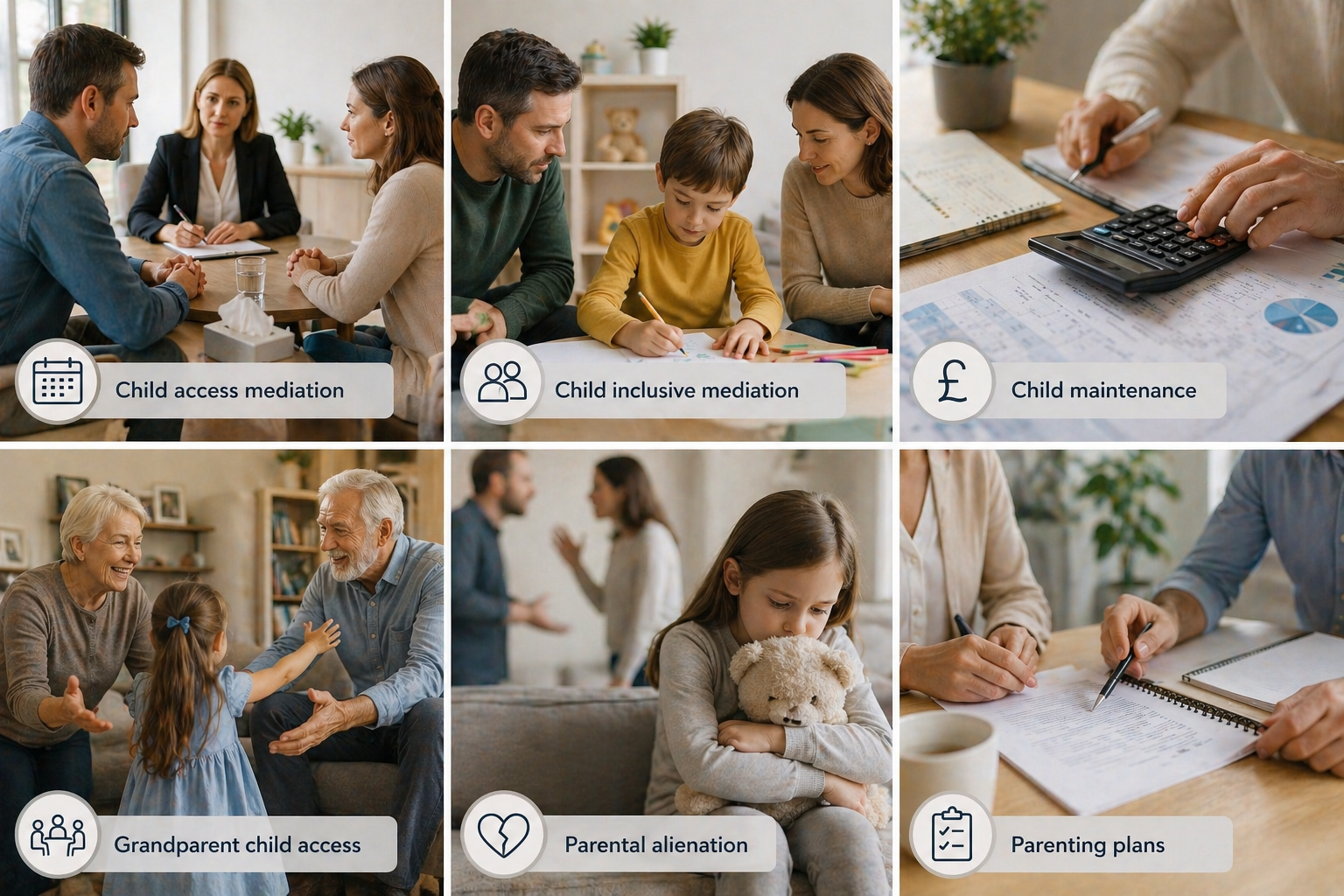
Child access mediation

Child access mediation supports parents in talking through how children will spend time with each parent after separation. Conversations might cover everyday plans, weekends, school pick-ups and drop-offs, holidays, birthdays, and how handovers should work. Without a clear shared understanding, these arrangements can come undone quickly. Misunderstandings build. Expectations slip. Children can feel unsettled, and parents can feel sidelined or excluded.

Mediation creates a steadier, more structured way to have these discussions. It allows both parents to set out what feels important to them and to consider how their child is most likely to feel supported. It also provides space to work through the practical details that often get lost when frustration is high. Access arrangements are rarely just about a schedule. They are about a child's sense of belonging, safety, and connection to both sides of the family. A useful conversation about access keeps those emotional realities in view alongside the practical ones. National Mediation supports parents through that work with care and patience, helping families build arrangements that are workable in everyday life and flexible enough to adjust as children grow.

Child inclusive mediation

Sometimes adults need a clearer sense of what their child is actually experiencing. Child inclusive mediation introduces that perspective into the process in a careful, age-appropriate way. Children should not have to carry the weight of adult disagreement. They should not be placed in the position of choosing sides or being asked to make decisions that go beyond what is fair to expect of them. They do, however, have feelings, experiences, and concerns that matter, and child inclusive mediation makes sure those things are not lost in the noise of adult discussion.

For parents, this can be a meaningful reminder that children are often more reassured by tone and consistency than by long explanations. They need to know what is happening, what will and will not change, and that the adults around them are working to keep life steady. National Mediation uses child inclusive mediation where appropriate to keep families connected to the child's reality. Children are not given responsibilities that are not theirs to carry. Their needs are simply better understood and respectfully reflected in the conversation.

Child maintenance

Child maintenance is another area where emotion and practicality often sit close together. Most parents want to be responsible for their children, but they may not always agree on what is fair, or how shared responsibilities should be balanced. These conversations can become difficult quickly. One parent may feel they are carrying more than their share. Another may see the picture differently if the figures were clearer. Financial pressure can make small differences feel larger than they really are.

Mediation gives families a calmer setting in which to look at these issues. It creates room to discuss real costs, day-to-day expenses, and what supporting a child practically actually involves. That can include school costs, activities, clothing, transport, and other ongoing needs. The value of mediation is not that it dismisses the disagreement; it is that it keeps the conversation centred on the child. National Mediation supports families in approaching child maintenance in a way that is realistic, balanced, and clear. The aim is to reach arrangements that genuinely support the child without turning parents against each other.

Grandparent child access

Grandparents are often among the most steady and important figures in a child's life. They can offer emotional support, structure, practical help, and continuity at times when other parts of family life feel uncertain. When a family separates or wider tension takes hold, those relationships can be disrupted. That can be painful for everyone involved. Grandparents may feel shut out. Parents may be juggling old strains and new pressures at once. Children may lose contact with people who have been deeply important to them.

Grandparent child access mediation gives families a respectful place to think about how contact can be sustained or rebuilt. These conversations often carry extra sensitivity because they are rarely just about access. They are about family identity, familiar relationships, trust, and long histories. Mediation helps to keep the discussion grounded and focused on the child's needs. National Mediation understands the importance of extended family. When supported well, those relationships can continue to bring real comfort and stability to a child going through change.

Parental alienation

Parental alienation can be one of the most sensitive challenges a family faces. When adult communication breaks down badly, children may feel pulled into the conflict emotionally — torn, confused, or caught between people they love. These situations need to be approached with care and balance. Blame, on its own, rarely helps. What helps is honest conversation, a clearer understanding of the patterns at play, and a willingness to examine how family behaviour is affecting a child's emotional wellbeing.

Mediation offers a safer framework for exploring these concerns. It can give parents space to reflect, and to consider what might support healthier communication and stronger relationships in the future. The focus stays on the child, not on escalating adult conflict. That is what makes mediation valuable in this kind of situation. It gives families a way to address something painful without immediately moving into a more adversarial environment. National Mediation approaches parental alienation concerns thoughtfully. The aim is to encourage understanding, reduce harm where possible, and help families move toward more stable long-term relationships in the child's interest.

Parenting plans

A parenting plan provides a useful framework after separation. It helps parents work through how children will be cared for and how important decisions will be made. That can include where the children live, how time is shared, how handovers and holidays work, how communication happens, and how the plan adapts as circumstances change.

A clear parenting plan reduces confusion and avoids unnecessary repetition of the same disagreements. It gives both parents a shared reference point, which can be especially helpful when emotions resurface or life becomes busy. Parenting plans should not be overcomplicated. They should be straightforward, practical, and shaped around the actual needs of the family. They should bring continuity for children and help each parent understand their role with confidence. National Mediation supports families in creating parenting plans that are sensible, easy to follow, and grounded in real life rather than theory.

Finance services

Five financial supports
Financial Services Guide

Financial issues are often closely tied to feelings of security, independence, and the future. That can make them more complex than the practical figures suggest. Discussions about debt, property, pensions, and shared money can quickly become emotional, leaving people feeling unable to think clearly. Mediation brings a calmer rhythm to those conversations. It gives people room to express concerns, gain a clearer sense of the financial picture, and move toward arrangements that feel fair and workable. National Mediation's financial services are built to support these difficult conversations with care and structure.

Debt mediation

Debt can be one of the most stressful elements of separation or family conflict. Shared responsibilities, outstanding balances, concerns about credit, and uncertainty over who is responsible for what can create lasting tension. Debt mediation gives families a structured way to talk through these issues more calmly. It allows both sides to look at current liabilities, future obligations, and possible ways to reduce pressure.

These conversations rarely succeed when they are rushed, because debt is not only financial. It can carry shame, fear, frustration, and worry about the future. Those feelings deserve recognition, even while the conversation stays focused on practical decisions. The aim is clarity. Once people have a clearer picture, they are better placed to decide what to do next. That can make a real difference, particularly when daily finances are already stretched. National Mediation supports families in approaching debt calmly, realistically, and with a focus on solutions rather than blame.

Financial mediation

Financial mediation addresses the wider financial picture that often surrounds separation, divorce, or longer-running family disputes. It can include income, savings, debts, assets, housing costs, and arrangements for the children's future support. These conversations are rarely purely technical. They are also about fairness, security, and what each person needs in order to move forward with confidence.

Mediation gives both sides space to set out their priorities and work toward a realistic, practical understanding. It creates an environment where financial discussions can take place without them turning into another argument. This kind of support also makes the workload feel less overwhelming, because mediation encourages people to walk through the financial picture in stages rather than trying to solve everything at once. National Mediation offers financial mediation with calmness and clarity, helping families reach decisions that hold up in everyday life.

Legal aid mediation

For some families, cost is a real concern. That can make it harder to ask for help, even when mediation would be useful. In some cases, Legal Aid mediation may be available, which can make the process more accessible for those who meet the relevant eligibility criteria. This matters because people often assume support is out of reach before they have explored what is actually available. Financial pressure can lead to delay, and delay can sometimes make the underlying situation more difficult.

Legal Aid mediation can open the door to a more constructive route forward at a time when it is most needed. It can ease the feeling that only expensive or adversarial paths exist. National Mediation explains the process clearly so people can decide on the right approach with the information they need. Knowing what support is available often removes a significant barrier and makes the next step feel more manageable.

Pension disputes mediation

Pensions are often one of the largest and most overlooked parts of a couple's financial picture. They can represent long-term security, future flexibility, and a meaningful share of shared wealth. They are also rarely discussed in detail because the specifics can feel complex or unclear. Pension disputes mediation gives families a place to work through these issues thoughtfully. It creates room to think about fairness, future implications, and how different choices may affect each person down the line.

These conversations matter because the decisions made today will shape circumstances years into the future. Mediation allows people to engage with this part of the financial picture rather than leave it unresolved or only partly understood. National Mediation gives pension discussions the attention they deserve, helping families approach a sometimes complicated area in a clearer, more accessible way.

Property division mediation

The family home often carries deep meaning. It is rarely just an asset. It holds memories, daily routines, a sense of stability for children, and a measure of the life that has been built together. Property division mediation gives families a balanced, structured way to discuss what should happen with the home and other shared property. The questions involved often include whether one person should remain in the home, whether the property should be sold, how shared equity is approached, and what the next step in housing might look like.

These conversations are unusually challenging because they bring together emotional and financial realities at the same time. Mediation helps to keep the discussion measured and ensures the conversation is not overwhelmed by emotion alone. With a steady hand, National Mediation supports families through one of the most difficult parts of separation in a way that feels calmer and more practical.

Divorce mediation

A more respectful path through separation

Divorce Mediation Guide

Divorce affects almost every part of life. Routines change. Plans around work and money shift. Living arrangements are reshaped. Wider family relationships often need to be rebalanced. Alongside all of that, there can be sadness, frustration, confusion, and even relief, sometimes at the same time.

Divorce mediation supports a more constructive way through that change. It gives the practical aspects of separation a calmer, more orderly place to be discussed. That can include decisions about children, finances, the home, and conversations with extended family. It is not about avoiding difficult subjects. It is about handling them with more care.

Mediation often feels more respectful than a process forced through court because it leaves the people involved as part of shaping the outcome. They retain a voice in decisions that will affect their lives. National Mediation brings a practical and emotionally aware approach to divorce mediation, helping people move forward with a sense of dignity intact.

Family mediation

Support for wider family disagreements

Family Mediation Guide

Not every family difficulty begins with divorce. Sometimes tension grows between family members over responsibilities, communication, contact, care arrangements, or changes in family dynamics that have never been fully addressed. Family mediation provides a space for those wider conversations.

It can support parents, adult children, grandparents, siblings, and other close relatives in talking through the issues with a steadier tone, and in developing a clearer understanding of one another's concerns. Family conflict can be especially complex because it tends to build over time. A current disagreement may sit on top of years of unresolved feeling, misunderstanding, or earlier difficulty. Mediation allows the immediate problem to be addressed without losing sight of the wider picture. National Mediation offers a gentle approach to family mediation, helping people reduce tension and focus on building more stable relationships where that is possible.

MIAMs

Beginning with information and reflection

MIAM Guide

A MIAM, or Mediation Information and Assessment Meeting, is usually the first step before formal mediation begins. It is an opportunity for people to understand what mediation is, whether it could work for them, and what the next steps might look like. It is a chance to talk through the situation, ask the questions that have been on their mind, and consider whether mediation feels like the right way forward.

A MIAM is not a commitment to mediate. It is an informed first conversation. That matters because many people arrive uncertain at the beginning, and they need a moment to process what is happening before making any further decisions. National Mediation treats MIAMs as a meaningful starting point rather than a formality. A calm, clear first meeting often makes the rest of the process noticeably easier.

Flexibility

Flexible support for modern family life

Online and Shuttle Mediation Guide

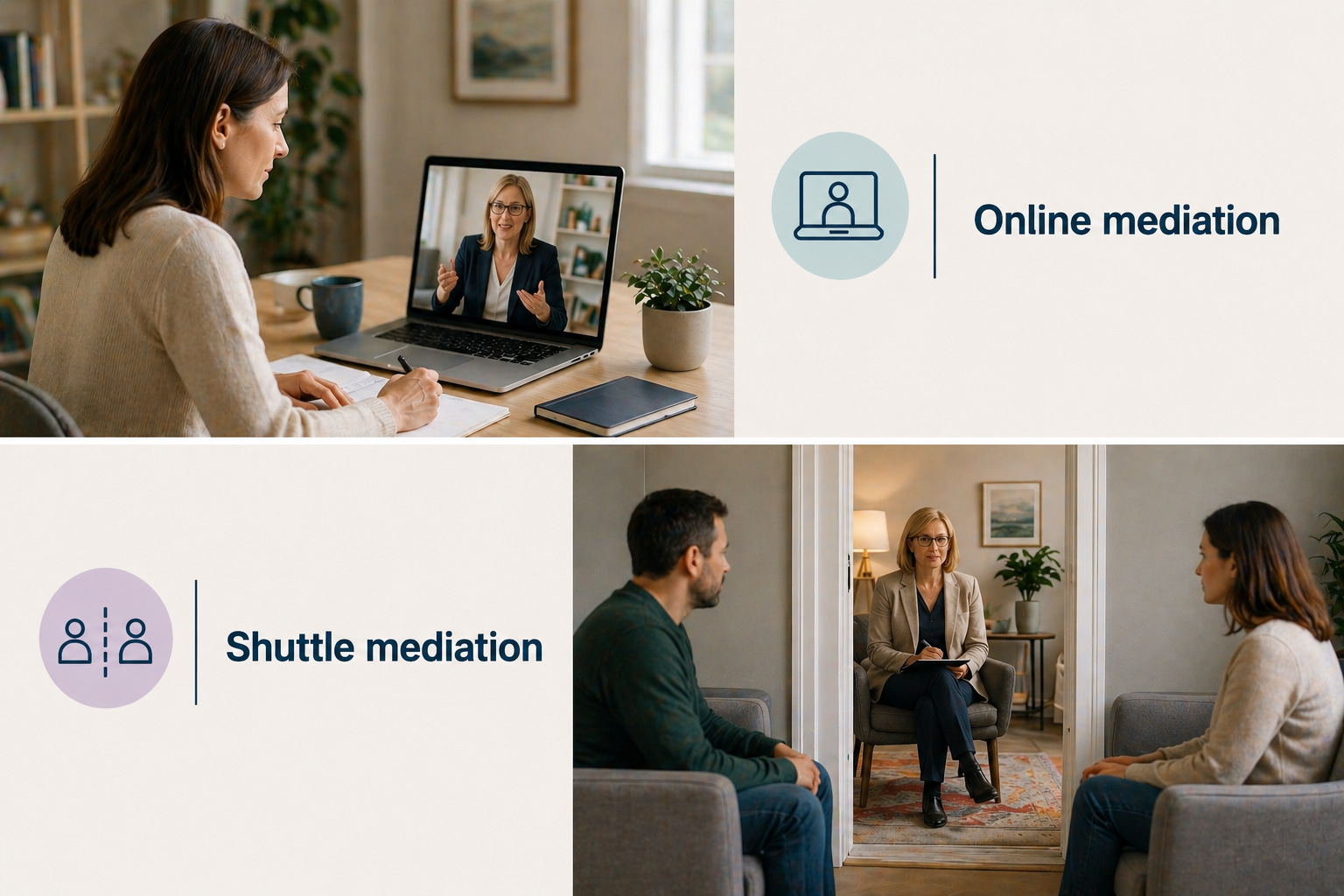
Online mediation

Not every family lives within easy reach of a single location, and not every schedule allows for in-person sessions. Work commitments, school routines, travel, childcare, and health considerations all shape what is possible. Online mediation reduces unnecessary disruption and lowers some of the practical barriers to engagement.

That flexibility can be especially helpful when in-person attendance would otherwise be difficult. It makes the process feel more accessible and reduces some of the everyday pressure that often surrounds family conflict. Online mediation remains structured and focused. It simply adapts more easily to real life. For families who need real support but also need real flexibility, National Mediation provides a practical option that does not compromise on care.

Shuttle mediation

Sometimes a direct conversation between the people involved feels too difficult to manage. Emotions may be running high. Trust may be strained. Communication may have reached a point where sharing the same space simply is not possible. In those situations, shuttle mediation can help. It allows the mediator to move between the two parties rather than asking them to speak face to face.

This format can ease pressure and help discussions stay clearer. It is not a lesser version of mediation. It is simply a different format that takes the emotional state of the people involved into account. National Mediation recognises that families need different kinds of support at different points. Shuttle mediation creates a respectful distance for those who need it, while still allowing the conversation to move toward agreement.

Why mediation

Why people choose mediation

People come to mediation for different reasons, but the underlying need is often similar. They want a calmer process. They want to feel heard. They do not want to make the situation worse than it already is. They want to make decisions that will actually work in everyday life.

Perhaps the most common reason people choose mediation is that it feels more respectful than a more confrontational route. It gives them space to take part in the conversations that shape their lives. That is particularly important where children are involved, because parents will often need to maintain some kind of working relationship long after the immediate situation has settled. Privacy matters too. Family matters are personal, and many people prefer a setting that feels less formal and more discreet.

Flexibility is another important factor. No two families are the same, and mediation is able to adapt to different needs, communication styles, and levels of readiness. National Mediation aims to offer support that is structured enough to work, flexible enough to feel realistic, and human enough to feel safe.

Heard

People remain part of the conversation, rather than feeling that decisions are being made around them.

Private

A discreet setting that suits the personal nature of family discussions.

Adaptable

The process meets families where they actually are, rather than asking them to fit a fixed mould.

Practical

The aim is workable arrangements, not symbolic outcomes.

The process

How the mediation process works

Mediation Process Guide

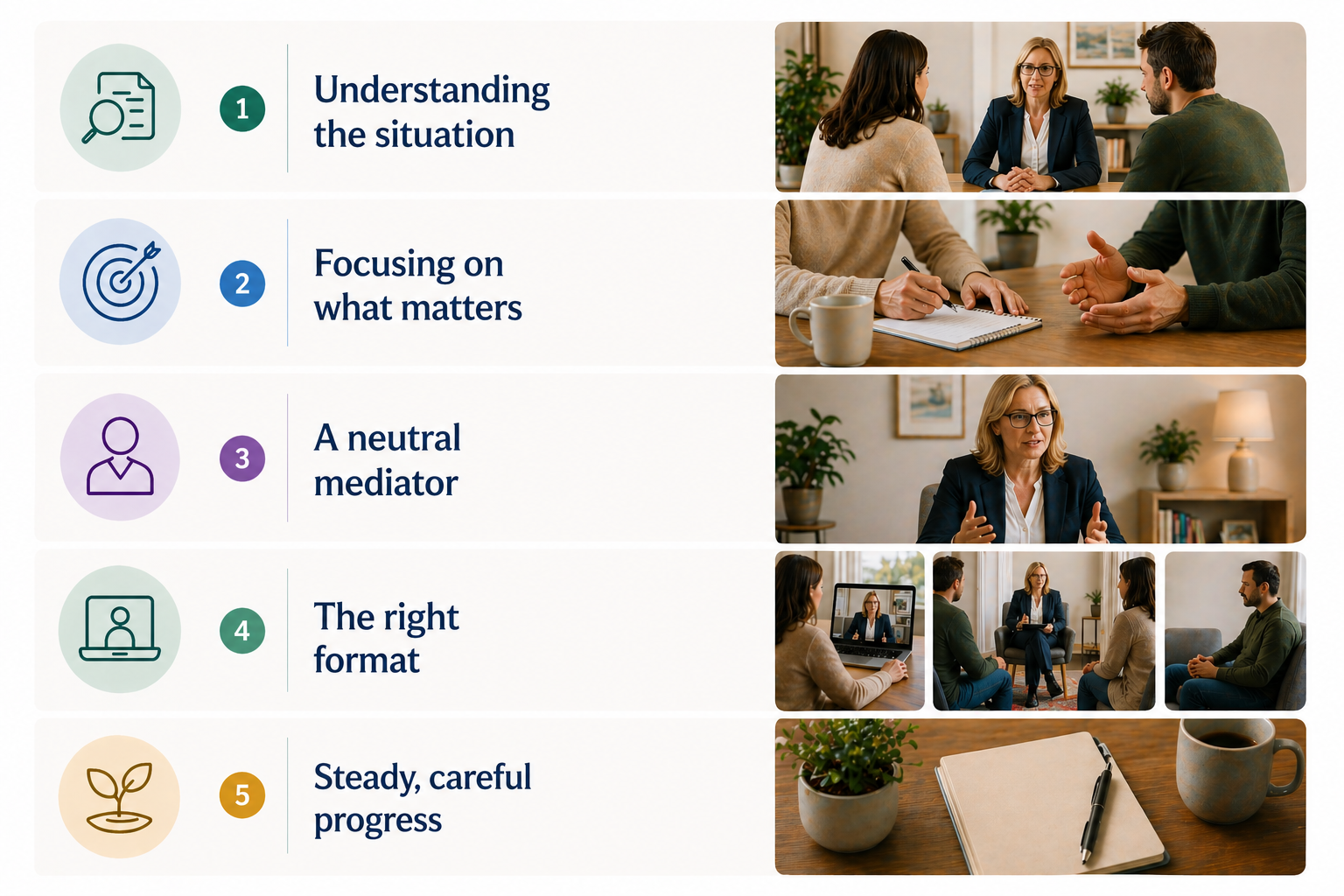
Understanding the situation

The process begins with a clearer view of what is happening. This often takes place during a MIAM, which provides space to discuss the situation and consider whether mediation is appropriate.

Focusing on what matters

If mediation is suitable, the next steps focus on the issues that need attention most. That may involve conversations about children, finances, property, divorce, or wider family conflict. The aim is to work through those topics in an organised way.

A neutral mediator

The mediator stays neutral throughout. Their role is not to take sides or impose an outcome. They guide the conversation, help maintain balance, and support practical progress.

The right format

Some people meet together. Others may find online mediation more practical. Some prefer shuttle mediation. The format adapts to the people involved, not the other way around.

Steady, careful progress

National Mediation works through the process at a pace that feels considered, so that each stage along the way feels clear and meaningful rather than rushed.

The wider value

The benefits of choosing mediation

Mediation can be a steadying support for families during periods of conflict or uncertainty. By creating a calmer, more respectful environment for difficult conversations, it tends to reduce hostility and allow people to listen and speak more clearly. That alone often leads to more useful, more practical decisions, because those decisions are shaped by the people most directly affected.

For families where children will continue to need both adults in their lives, mediation can help preserve a more functional working relationship. That kind of stability often translates into less confusion and more steadiness for the children themselves. Compared with prolonged conflict, mediation is generally more time-aware and easier on people emotionally. It does not erase the difficulty of the situation, but it tends to give families a more consistent path through it.

National Mediation supports people in drawing on these benefits in ways that feel realistic, actionable, and respectful. It is a service designed to help families find clearer ground through About Us without losing sight of the human side of what they are going through.

Mediation does not make difficulty easier. Its real value is that it makes difficulty more manageable. It opens space for clearer thinking, calmer conversation, and decisions that hold up in real life.

What mediation can offer

Common questions

Frequently asked questions

What services does National Mediation offer?

The services include support around children's arrangements, child maintenance, parenting plans, grandparent access, parental alienation concerns, debt and financial discussions, Legal Aid mediation, pension disputes, property division, divorce mediation, wider family disputes, MIAMs, online mediation, and shuttle mediation.

Is mediation only for separating couples?

No. Mediation can support many types of family situation. That includes parenting questions, disputes between extended family members such as grandparents, and wider family disagreements that have nothing to do with separation.

Does mediation work when communication has broken down?

It can, and it is often most useful in exactly those situations. Shuttle mediation, online mediation, and other formats allow communication to continue in a safer, more manageable way when direct conversation feels too hard.

Is mediation the same as going to court?

No. Mediation is a private process where the people involved work through their issues with a neutral mediator guiding the conversation. Court is a formal legal process where decisions are made by a judge. Mediation is generally a quieter first step.

What is a MIAM for?

A MIAM is a Mediation Information and Assessment Meeting. It helps people understand what mediation involves, ask questions, and decide whether it is the right approach for their situation.

Can mediation cover children and finances at the same time?

Yes. Many families use mediation to discuss both. Children's arrangements and financial matters can be addressed within the same wider mediation process.

Does online mediation work as well as meeting in person?

For families who need flexibility or cannot easily meet in person, online mediation is a workable option. The structure of the process remains the same; only the setting changes.

What if one person feels much more emotional than the other?

This is common. Mediation is designed to manage situations where people are at very different emotional points. The process can be adjusted to keep the conversation focused and useful.

Does mediation require both people to agree?

Mediation aims to support agreement, but it does not impose one. The goal is to provide enough clarity and structure that practical decisions become possible.

Can mediation help with long-running family conflict?

Often, yes. Mediation can be particularly useful when families have felt stuck for a long time. A different kind of conversation can help people move past patterns that have not been resolved through earlier discussion.

A final reassurance

Steadier ground for families ready to move forward

Family change has practical effects, but it also has emotional ones. Children need stability. Adults need clarity. Anyone moving through a difficult moment in their family life needs space to rebuild without further weight being added on top of what is already there.

That is the role National Mediation aims to play. It brings together a full set of family mediation services — supporting children's matters, financial conversations, divorce, property, MIAMs, and wider family disputes — in one calmer, more compassionate place. Mediation does not make difficulty disappear. What it does is give people a steadier way to manage it. It opens space for clearer thinking, more respectful conversation, and decisions that can stand up to real life. For families ready to move from confusion toward clarity, from conflict toward conversation, and from pressure toward a steadier next step, National Mediation offers a human, practical place to begin.