

A calmer way to move forward through family change

When family life shifts, even ordinary conversations can begin to feel heavy. National Mediation offers a steady, dignified place to talk through what comes next — for separation, parenting, finances, housing, and the wider conversations that matter most.

Confidential Considered pace Neutral and balanced

Welcome

A considered approach to family transition

If family life is changing, even a simple greeting can begin to feel difficult. Small disagreements grow heavier. Bigger questions about children, finances, the home, and the future can leave a person feeling stuck or weighed down by anxiety. There is rarely a clean answer to where to begin.

National Mediation offers a consistent, dignified starting point. It is suited to people who want a more thoughtful approach to family matters, without the need to argue at every step. It allows difficult conversations to happen properly — with care, structure, and an honest eye on practical next steps.

Mediation is not about gathering everyone in one room and forcing agreement. It is about helping people speak more clearly, listen more calmly, and move toward arrangements that are fair, practical, and grounded in real life. For many families, that quiet shift in tone changes everything.

Some families are simply tired of contention. They want clarity. They want a process that feels less combative and more human. They want to discuss serious matters without losing sight of what matters most. That is the spirit National Mediation is built around.

This service supports people who are navigating separation, divorce, parenting questions, financial decisions, property concerns, and wider family disputes. It brings shape to conversations that have long felt out of reach — with respect for privacy, dignity, and the emotional reality of family change.

What it is

Understanding what mediation is

Mediation is a guided conversation. In a structured, facilitated setting with a neutral, trained professional, people are able to talk openly about what is affecting them. There is no attempt to decide who is right or wrong. The aim is to bring clarity to the situation for everyone involved, and to build practical outcomes that can hold up in everyday life.

Described that way, it can sound straightforward. In practice, it is often invaluable. Most families do not struggle through a lack of love or care. They struggle because emotions are running high, trust has been bruised, communication has broken down, or too many complex decisions need to be made at the same time. Mediation creates a more workable path through that complexity.

It helps people to navigate transition, to think clearly about what comes next, what the children need, how money will be managed, who lives in the home, how future contact may work, and how a family can settle into a new shape with reasonable stability. The process is flexible, but it is also rooted in reality. It gives direction to conversations that have lost their footing.

National Mediation is for people who value support without unnecessary drama. It allows things to move forward while leaving room for the heart of family transition. That balance matters, because families are never simply legal cases or bullet points. They are people with daily lives, memories, responsibilities, and futures that need to continue beyond the difficult choices being made.

Our guiding principle

Why it matters

Why many people choose mediation

One of the main reasons families choose mediation, rather than going straight to court, is that it tends to feel more respectful. It allows people to remain involved in the decisions that matter to them. That can be especially important where children are concerned, or where two people will need to keep working together in some capacity after separation.

Approaching court can feel slow, formal, costly, and emotionally draining. Instead of bridging the distance between people, it can sometimes widen it. Mediation takes a different route. It creates a space where people can stay connected to the real challenge in front of them and work through it one step, and one issue, at a time.

Privacy is another reason mediation appeals to so many. Family matters are deeply personal. Most people do not want those details aired in a public or combative setting. Mediation offers a more private environment where these conversations can take place with discretion.

People also value the flexibility. Every family is different. Every separation is different. Each home, each routine, each child, and each financial situation has its own shape. Mediation can adapt to that. Families do not need to fit themselves into a fixed process; the process can meet them where they actually are.

For many, mediation also feels more approachable. People may not be familiar with legal language. They may have never been through formal dispute processes before. They may simply be exhausted. Mediation can make the next steps feel less intimidating, and more like a conversation than a confrontation.

National Mediation understands that most people arrive at this stage after a long period of difficulty. The tone matters. The process matters. The way information is presented matters. The aim is to ease pressure, not to add to it.

Structured

A guided process that brings shape to difficult subjects, so that conversations stop circling and start moving forward.

Considered

An approach that takes time when time is needed, rather than rushing people through the most important decisions of their lives.

Practical

Focused on outcomes that can survive Monday morning — workable arrangements that hold up across school runs, bills, and shared routines.

Respectful

A tone that protects dignity, even when the subject matter is hard. People should feel met, not managed.

Real life

A service designed around the realities of family living

Family difficulty rarely arrives at a convenient moment. It happens alongside the working week, school runs, broken sleep, money pressures, and emotional exhaustion. People have to carry on living while everything around them feels uncertain.

An effective mediation service has to recognise that. It cannot pretend that life pauses while important decisions are made. It must understand that people are not just confronting legal questions; they are also juggling routines, care arrangements, shared responsibilities, housing, and the quiet weight of emotional fatigue.

National Mediation is built for that reality. It supports conversations that take place beside ordinary life, rather than asking people to set ordinary life aside. It offers families a route forward without requiring every detail to be solved at the start. And that is what most people need — not perfection, but a way to begin.

You do not need to feel confident or composed to start. Many people put off seeking help because they hope things will improve on their own. Some worry that mediation will feel formal or intrusive. Others simply do not know where to start. National Mediation is here for the stage before everything is figured out. It supports people from where they are, not from where they think they should already be.

What it can support

Family matters mediation can help with

Mediation can support many different family situations. Some people are separating after a difficult period and need help thinking through practical next steps. Some are already living apart but need to rework arrangements that no longer fit. Others are trying to settle disagreements before they grow into something larger.

Children and parenting

Where children live, how time is shared between parents, school weeks, weekends, holidays, handovers, and the everyday routines that keep family life steady.

Finances and money

Shared income, bills, debts, savings and other financial responsibilities — discussed in a calmer setting where decisions can be made with a clearer head.

Property and the family home

Conversations about what happens to the home, how shared property is approached, and what a workable next step in housing might look like.

Wider family communication

Tensions between partners, adult children, grandparents, or close relatives — situations that need an organised conversation rather than another argument.

Most importantly, the process focuses on the actual problem the family is facing. That problem is rarely a single argument. It is usually about the next chapter of life, and how to make that chapter stable enough for everyone to live within. National Mediation helps to bring that focus back into view.

Parenting

Children and parenting arrangements

Everything feels more sensitive when children are part of the conversation. Most parents want the same essential things: that their children feel safe, settled, and well looked after. Even when that intent is shared, the path to agreement can feel long.

Children need consistency. They need emotional steadiness. They need routines they can rely on, and adults who are able to make calm decisions even when the underlying issues are painful. Mediation provides a useful place for parents to think through these practical needs together.

It can support discussions on where children will live, how much time is spent with each parent, how transitions between homes are handled, what schooldays look like, who has the children at weekends, and how birthdays, holidays, and important moments are shared. It can also encourage parents to think about the tone they use with each other, which matters greatly to children adjusting to change.

Keeping the emotional side of parenting in view

Children sense family change even when adults work hard to shield them from it. They notice tension. They pick up on silence. They often feel more than they show. So parenting decisions need more than logistics — they need sensitivity.

Mediation gives parents room to consider not just what is possible, but what is most likely to settle and reassure their children. That includes tone, timing, the rhythm of transitions, the way information is shared, and the longer arc of the relationship as it changes shape.

Many parents arrive at mediation carrying fear. They may be afraid of being unheard. They may be afraid of giving up too much. They may be afraid that the distance between them will harden into something permanent. Those fears are understandable. Mediation does not ignore them. Instead, it gives them a place to be acknowledged and worked through.

One of the strengths of mediation is that it stays close to the child's everyday reality. Children do not usually need their parents to feel the same way. They need their parents to act in ways that are consistent, calm, and gentle enough to soften the edges of change. National Mediation works to keep that need at the heart of parenting conversations.

Finances

Financial and property matters

Money can be one of the most difficult parts of separation. It rarely comes down to numbers alone. It tends to involve security, fairness, and the future, and often the home a family has built together. Conversations about income, savings, debts, pensions, property, living costs, and future support can quickly feel overwhelming.

Some people worry about being treated unfairly. Some worry about whether they will have enough to manage. Some are unsure what is realistic. Mediation can make these conversations easier to begin. It allows people to look at how the practical picture actually fits together, without every detail turning into another disagreement.

It can support discussions about the family home, what happens with shared assets, and what each person needs in order to move forward with reasonable confidence. The process is particularly helpful when conversations about money have been stuck for some time. Financial uncertainty creates pressure across housing, childcare, work, and emotional wellbeing. Mediation gives that uncertainty a clearer shape.

The home and what it represents

A family home usually carries far more than its financial value. It holds routines, memories, and a sense of normality. When separation involves the home, the conversation quickly becomes personal. Some people want to stay. Some need to move. Some simply do not know what is possible. Some are trying to understand how property is approached and what doors might open next.

Mediation creates a steadier place to look at the housing picture. It allows both people to set out what is important to them, and to do so alongside the practical realities of the situation. That tends to lead to more useful conversation than a sentence said in frustration ever could. When people are able to talk about what the home represents, they often find solutions that are not just technically possible but emotionally workable as well. It does not mean everyone walks away delighted. It does mean the result is more likely to be steady and considered.

First step

Understanding the role of a MIAM

MIAM stands for Mediation Information and Assessment Meeting. In many family situations, this is the first step before mediation begins. Its purpose is to help people understand what mediation is and whether it fits their situation.

It is an opportunity to talk through what is going on, identify the key concerns, and consider what kind of support could be useful. It is also a chance to ask questions about the process itself in a calm, confidential setting. A MIAM is not a commitment to mediate. It is a conversation that allows people to learn, reflect, and decide whether mediation is the right route for them.

For many people, that first meeting brings reassurance. It allows the dust to settle a little before anything more formal happens. National Mediation takes that first step seriously. People often arrive at this stage feeling uncertain, anxious, or guarded. That is entirely normal. They may worry about being judged or pushed. A good MIAM aims to do the opposite. It is meant to leave people informed, not pressured.

It should also help to identify whether the matters at hand can sensibly be discussed in mediation, what would need to be in place for those conversations to happen, and what the next step might look like.

The process

How the mediation process works

process

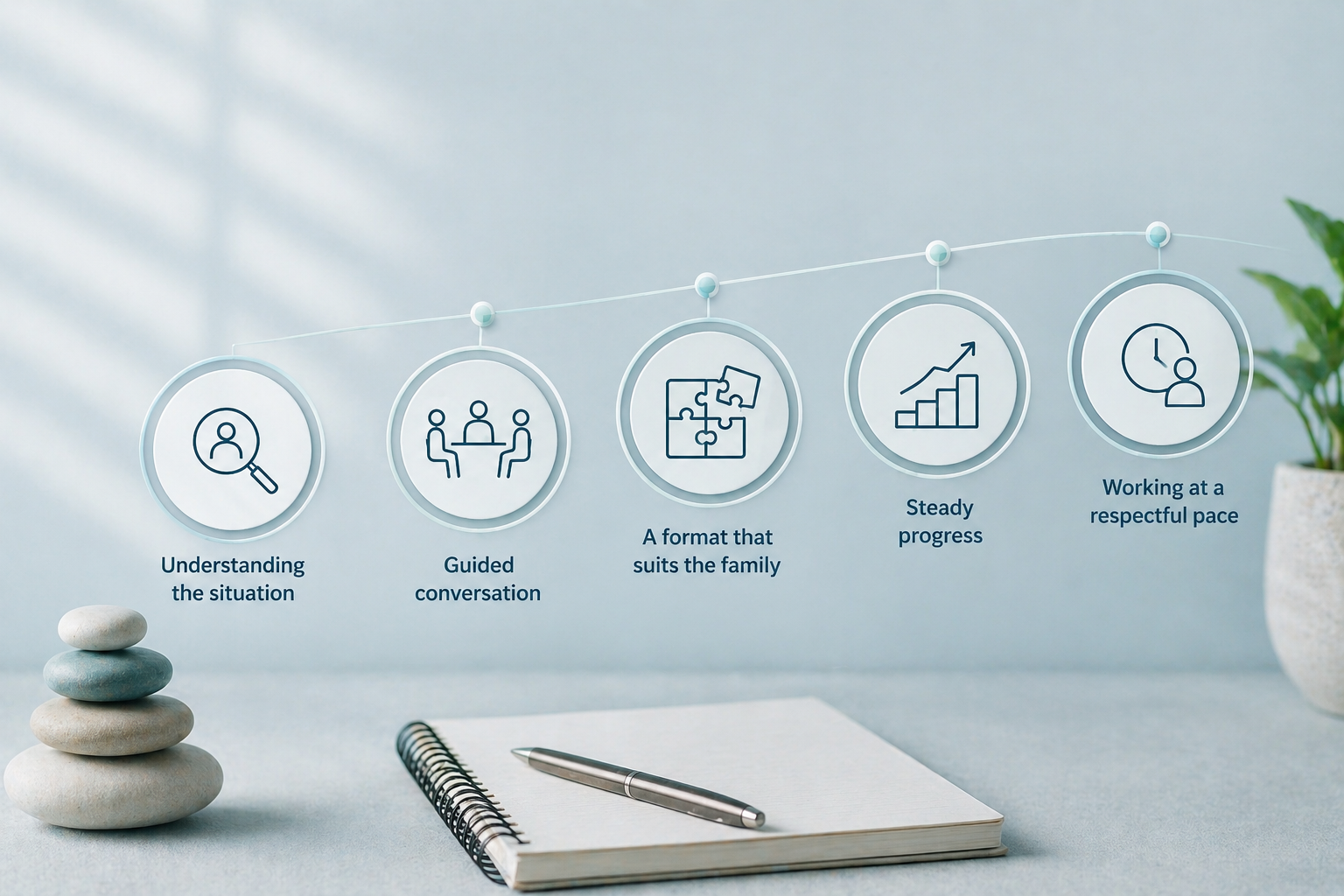
Mediation usually moves through a series of small, clear stages. Each one is designed to make the next one easier.

Understanding the situation

Mediation usually begins with a careful look at what is happening and what feels most pressing. Once that is clearer, the conversation can move toward what needs to be discussed first — whether that is something to do with the children, a financial concern, or another part of life that has stalled.

Guided conversation

The mediator's role is to support the conversation, keep it on track, and ensure both people are able to take part in a constructive way. The mediator stays neutral. They do not make decisions. They help create the conditions in which the people involved can shape their own.

A format that suits the family

The shape of mediation depends on what is needed. Some families talk together. Others may prefer a different format, especially if direct conversation feels too difficult at the start. The process can usually be adapted to help people feel more able to engage.

Steady progress

Progress tends to come step by step. Family disagreements are rarely solved by one long conversation. They usually need a series of small, clear discussions that bring the issue into focus and make it feel more manageable.

Working at a respectful pace

Every family moves at its own pace. Some people are ready to engage early. Others need more time. Some arrive with a clear idea of what they want. Others are still working out what matters most. A thoughtful mediation service makes room for that difference.

A different route

Why mediation can feel less stressful than court

Court has its place in family law, but not every family wants or needs to begin there. Mediation tends to feel less pressured because it is conversational rather than adversarial. People remain part of the discussion, rather than feeling that decisions are being made around them.

Court can feel formal and unfamiliar. There is often more waiting, more procedure, and less space for the human side of things. Mediation is a different experience. For families that want to try a more cooperative approach first, it is often a better fit.

That does not mean mediation is easy. Hard conversations remain hard. They are simply more manageable when there is calm and a clearer sense of purpose around them. Even before any final outcome is reached, people often leave mediation feeling that they understand more than they did. That sense of direction can be a real relief after a long stretch of feeling lost.

Confidence in the process

Confidentiality, neutrality and trust

Privacy matters in family matters. People need to know that what they share is being handled with care. Mediation provides a confidential setting in which sensitive subjects can be discussed. That privacy supports honest conversation. It makes it easier to acknowledge worries, raise concerns, and consider options. When people feel that a conversation is being treated with respect, they are more likely to take part fully.

Tone is a large part of trust. A calm, courteous approach creates the right conditions for problem-solving. The human side of mediation matters. It is not only rules and steps; it is the way people are treated while they move through one of the more difficult periods of their lives.

Neutrality is what makes mediation work. The mediator does not take sides. They remain impartial and focused on guiding the conversation. That allows both people room to share their perspective, raise concerns, and feel heard, while keeping discussion constructive rather than circular. Fairness does not always mean everyone leaves happy — that is rarely possible in family disputes. It means the process gives both sides a fair chance, and that the way it is run reflects that.

Flexibility

Online and shuttle mediation options

Online mediation

Not everyone is able to meet in the same place at the same time. Whether the reasons are work, childcare, distance, health, or simply the need to feel emotionally safer in a familiar setting, the way people take part in mediation matters.

Online options can make the process easier. They reduce travel, simplify scheduling, and allow people to join from a place where they feel more at ease. For many, that helps them stay engaged and focused. Family life is already full. A process that fits around real life is usually more effective than one that adds extra pressure on top.

National Mediation believes that flexibility should not come at the cost of structure. Online sessions still feel guided, supportive, and clear. They simply meet people where they actually are.

Shuttle mediation when speaking directly is too hard

Sometimes people are not ready to speak with one another in the same room. Feelings may still be raw. Past events may feel too recent. Communication may have broken down to the point where another format is needed. Shuttle mediation allows the mediator to move between the parties, rather than asking them to speak face to face.

That can ease pressure and make it possible to keep moving forward when direct dialogue feels like too much. It is not a lesser form of mediation. It is simply a different way of supporting the same conversation. National Mediation recognises that how people communicate after separation matters as much as what they decide. Shuttle mediation helps create the conditions in which calmer communication can begin to grow.

A good fit

When mediation may be right for you

mediation may be right for you

Mediation tends to suit people who want to address family matters in a calm, practical, and private way. It works particularly well when there is some willingness to try. That willingness does not need to be confidence; it just needs to be openness to the idea that another approach is worth attempting.

It is also helpful when people want to remain involved in decisions that will shape their own lives and the lives of their children. Many families value being able to influence the outcome themselves rather than have it imposed from outside.

When the question is not whether a family can move forward, but how, mediation has a particularly important role. That question is often the hardest to face. Mediation provides a setting where it can be approached gently and steadily. Even when the wider picture is still unclear, it gives people a way to identify a clear next step.

When people feel stuck

One of the most common reasons mediation enters the picture is the sense of being stuck. Conversations may have been attempted again and again, only to repeat the same arguments. There may be a decision that clearly needs to be made, but no obvious way to reach it without things getting worse. That kind of stuckness is exhausting. It can affect sleep, work, parenting, and day-to-day wellbeing. Even the smallest exchanges can feel charged.

Mediation can interrupt that pattern. It creates a setting for the conversation that no longer needs to circle the same unresolved point. It is not magic. It will not erase the hurt of separation or the cause of disagreement. But it can move a stalemate into motion, and motion matters. Even small steps can help people feel a little more in control of what comes next. National Mediation supports people who feel weighed down by the situation and unsure of where to begin. The first step is often the hardest. Once any part of the conversation starts, the path tends to become a little clearer.

The human side

Recognising the human element of family change

Family change is rarely tidy. It touches identity, routine, home life, finances, confidence, and plans for the future. People may feel sadness, frustration, anger, relief, and guilt all at once. That is why the tone of any support service matters so much.

National Mediation treats family change as a meaningful experience, not a mechanical process. It acknowledges that people are carrying real emotional weight. Language should be clear, but also kind. The process should feel practical, but never cold. People often forget what was said, but they remember how they were treated. When someone feels respected, a difficult process becomes easier to sit with. When someone feels dismissed, the same process becomes much harder.

Clarity

Plain language used with care, so people understand what is happening and what comes next.

Patience

Room for people to think, breathe, and find words for things that have felt unspoken.

Balance

A neutral approach that gives both sides a fair place in the conversation.

Care

Attention to the emotional side of family life, alongside practical decisions.

People often arrive at mediation already worried about how the process will feel. They may wonder whether it will help. They may worry the other person will not engage. They may fear being pressured into something that is not fair. They may be concerned that revisiting painful subjects will only make things worse. These worries are understandable. People do not arrive at mediation because life is simple. They arrive because life has become more than they can hold alone.

A good mediation process makes room for those worries and addresses them clearly. It explains what mediation is, and just as importantly, what it is not. It sets realistic expectations. It avoids false reassurance. It gives people enough information to decide whether this is the right path for them. National Mediation aims to do exactly that. People should not be left wondering. They should feel informed enough to take the next step with confidence.

Clarity is calming when families are dealing with uncertainty. It does not solve everything, but it removes some of the weight that comes from not knowing. One of mediation's quiet strengths is that it turns shapeless worry into clearer conversation.

Why clarity matters

When people no longer feel that everything is happening at once, they can take things one part at a time. They can move from reacting emotionally to thinking practically. Instead of drifting further apart, they can begin to build a workable framework for what comes next. National Mediation supports that shift gently. It gives people language, structure, and space to think. Those things sound simple, but they can make an enormous difference when life feels unsteady. Clarity is often the first real sign of progress.

The wider picture

A more thoughtful way forward

For most families, mediation is not the easiest answer. It is the more thoughtful one. It asks people to keep talking, to focus on what matters, to weigh the practical alongside what feels fair. That can be difficult. It can also lead to better outcomes for everyone involved. When parents are able to communicate more calmly, children tend to fare better. When adults can avoid prolonged conflict, life is generally more bearable. When decisions are made through some level of mutual understanding rather than ongoing dispute, the future tends to feel more stable. That is the spirit National Mediation supports. It offers families a steadier starting point, even when the situation feels far from steady. It moves people away from the heat of emotion toward a place where decisions can mean something. That is no small thing. It can shape the next months, the next years, and in some cases the entire atmosphere of post-separation family life.

Common questions

Frequently asked questions

What is the main purpose of mediation?

The main purpose is to support family matters in a structured, calmer setting. It is designed to keep conversation useful and grounded, without turning every issue into a formal dispute.

Is mediation only for separating couples?

Not at all. Mediation is often associated with separation and divorce, but it can also support wider family conflict, parenting questions, and disputes between extended family members.

Do both people need to want mediation?

Mediation works best when both people are open to taking part. Even if the situation feels strained, a shared willingness to try is enough to begin. The process supports conversation; it does not force agreement.

Can mediation help with arrangements for children?

Yes. Mediation can address where children live, how time is shared, how communication is handled, and how routines are organised. It is particularly helpful when parents want to keep the child's wellbeing at the centre of decisions.

Can mediation help with money and property?

Yes. Mediation can support conversations on finances, debts, assets, and housing. It allows these subjects to be approached in a more organised, less adversarial way.

What happens first?

The first step is usually a MIAM, which provides information and helps decide whether mediation is the right option. For many people, that first conversation makes the process feel less unfamiliar before anything more formal happens.

Is mediation confidential?

Mediation is designed to be a private and confidential setting. That makes it easier for people to speak honestly during the process.

What if we can't talk to each other directly?

Shuttle mediation may be a useful option if direct conversation feels too difficult. The mediator moves between the two people instead of asking them to speak face to face.

Do we have to agree on everything?

Mediation aims to support agreement, but it does not require it. It offers a structured way to look at the issues and see whether a workable outcome is possible.

Is mediation faster than going to court?

It often can be, though every situation is different. The bigger benefit is usually around easing pressure and helping people make practical decisions with a calmer mindset.

A closing thought

Steadier ground, one conversation at a time

When family life shifts, people need more than information. They need a process that does not feel sterile. They need a place where difficult things can be said without the situation falling apart. They need support that recognises the emotional cost while staying alert to the practical decisions that still need to be made.

That is what National Mediation aims to be. It offers a calmer way for people to speak, think, and decide. It allows families to work through complex matters with dignity, respect, and structure. It does so while staying grounded in real life rather than abstract theory.

For people facing separation, parenting questions, financial worries, property matters, or longer-running family difficulty, mediation can offer a steadier route forward. It will not remove the challenge, and it will not make the journey simple, but it can make the path clearer and the load a little easier to carry. National Mediation is here for that work — for less noise, more understanding, and for families that need a way to move forward.